Amphibious Access Point

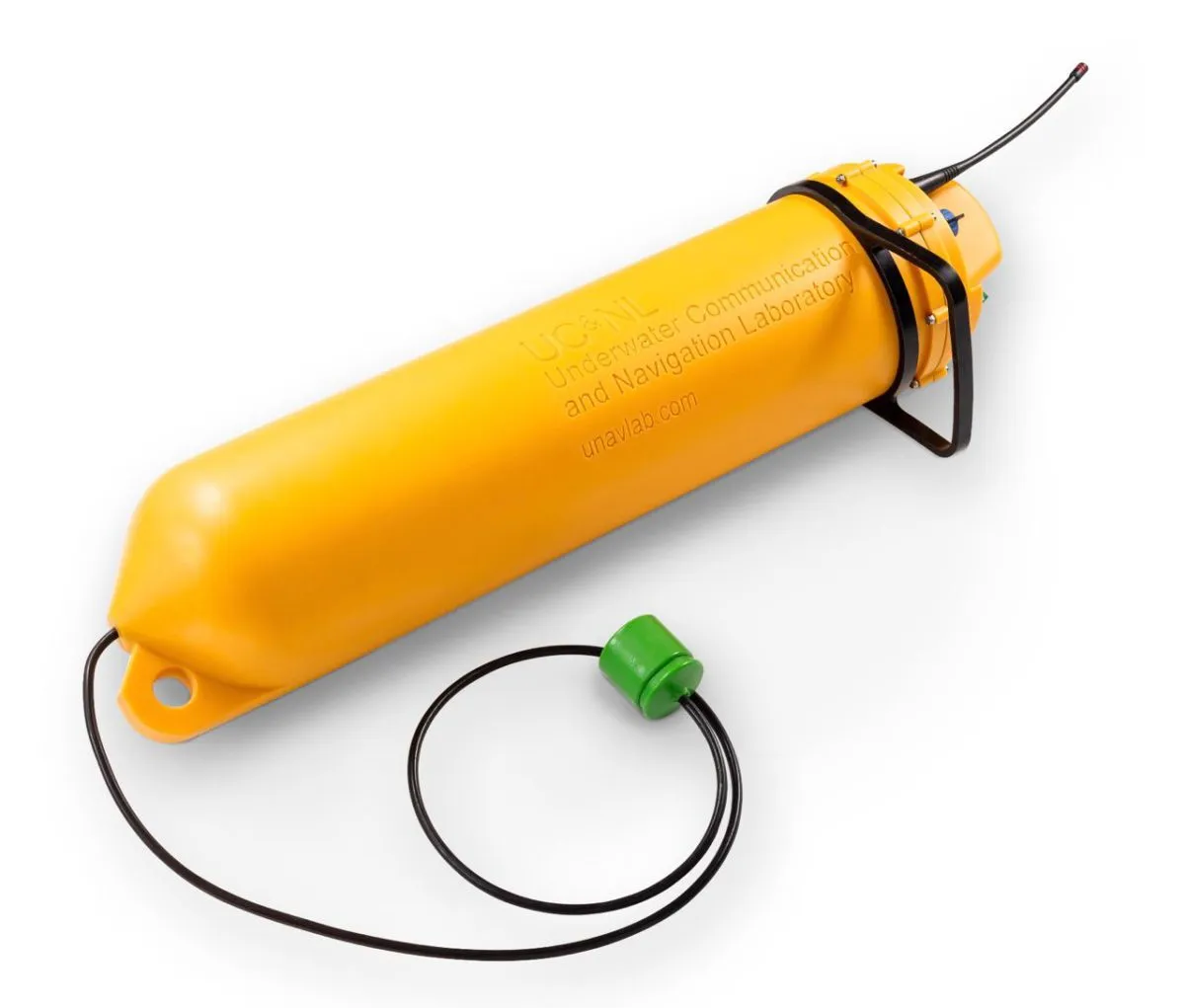
Amphibious Access Point
Receive sensor data from underwater objects, control underwater mechanisms, and determine the geographic position of underwater network nodes
The Amphibious Access Point consists of a "surface part" — a module providing Internet connectivity and GNSS reception — and an "underwater part" — a module providing data exchange and positioning under water.
So that you can make an informed decision about whether the device suits your tasks, we have prepared a detailed description of the Amphibious Access Point, its technical specifications and its communication protocol.
Network scale and protocol
The access point coordinates the network using the specialized Hadean protocol. According to our article Applications of our devices, such a system serves up to 256 dynamically addressed nodes transmitting telemetry and user data, up to 250 four-command actuator control nodes and up to 49 twenty-command actuator control nodes. Broadcast commands can be sent to both types of control nodes.
When you need an access point
The Amphibious Access Point is the right choice when underwater sensors and actuators must be reachable from the global network and you also need to know the positions of the network nodes. If positioning is not required and you only need to control underwater objects, the RedGTR code modems are a good fit.
Learn more
The overall picture of the solution is in the Internet of Underwater Things section. The access point's technical specifications and a description of its communication protocol can be requested from our specialists through the form on this page.
- Universal installation. The device can be free-drifting or tethered to a surface object — a vessel, a moored buoy, etc.
- Long-range data transmission. Depending on the version, the device provides data exchange at distances of up to 8 km without repeaters
- Reliable communication. A dependable signal, field-tested in real conditions. Guaranteed-delivery mode is implemented at the device level
How most analogous systems work
Almost all similar devices were built around point-to-point communication and complex routing methods. Such a system involves a large number of repeaters, which unambiguously reduces the reliability of the system as a whole.
The more repeaters involved in data transmission, the higher the probability of error at each node. Message latency and routing overhead also increase.
How the Amphibious Access Point works
Our approach is based on completely different processes and protocols. Network coordination is handled by the Amphibious Access Point: data transmission occurs only on the access point's command, which avoids collisions even with a large number of network elements. The many-to-one protocol and impressive operating range eliminate the need for repeaters and reduce the probability of errors caused by a large number of unsynchronized transmitting devices in the water.
The access point optimally allocates time between your devices, so you receive all your data on time and without loss.
Want to learn more about how the Amphibious Access Point works?